
Why Visible Damage Isn't the Whole Picture
Water moves along the path of least resistance, which is rarely a straight line. A leak at one point on a wall can travel sideways along framing, downward with gravity, or upward through wicking, showing up as damage several feet from where the water actually entered. Relying on what's visible often means missing most of the affected area.
This is why professional assessment relies on instruments rather than a visual walkthrough alone. The goal is to map moisture accurately before deciding what needs to be dried, opened up, or removed.
Moisture Meters: The Primary Tool
Non-Penetrating Meters
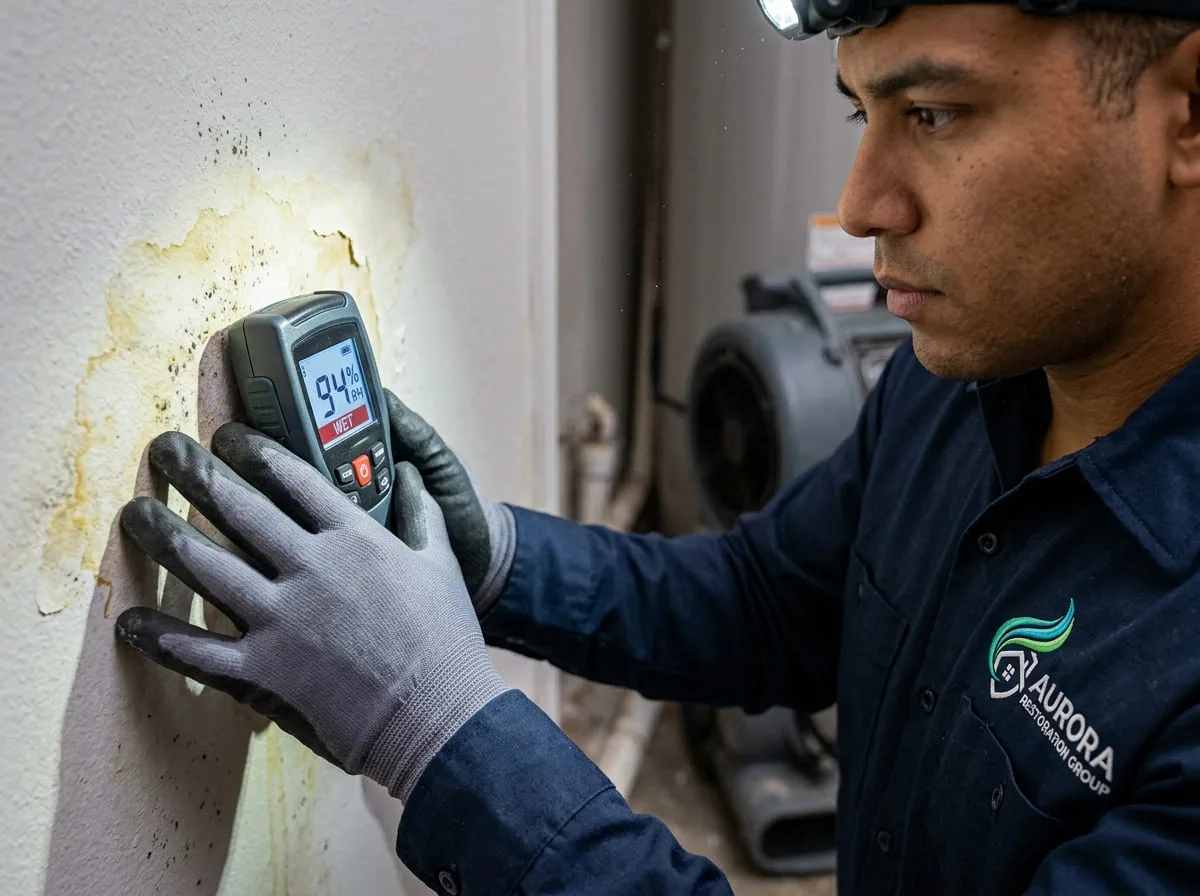
Non-penetrating (or non-invasive) moisture meters use electromagnetic sensors pressed against a surface to estimate moisture content without creating any holes. These are typically used first, as a fast way to scan a wide area and identify where more detailed investigation is needed.
Penetrating Meters
Penetrating meters use small pins inserted into the material to get a more precise moisture reading at a specific depth. These are more invasive but give a clearer picture of saturation inside the material rather than just at the surface, which matters when deciding whether a wall section can be dried in place.
Thermal Imaging: Seeing Temperature Differences
How It Works
Thermal (infrared) cameras don't detect moisture directly — they detect temperature differences on a surface. Wet areas often show up as cooler than surrounding dry material due to evaporative cooling, which lets technicians quickly scan a large wall or ceiling area and flag zones worth checking with a moisture meter.
Why It's Used Alongside Meters, Not Instead of Them
Thermal imaging is a screening tool, not a final answer. A cool spot on a thermal camera could be moisture, but it could also be an insulation gap, an air draft, or a difference in wall material. That's why any area flagged by thermal imaging gets confirmed with a moisture meter before it's treated as a wet area needing attention.
Physical Inspection Techniques
Small Inspection Holes
When surface readings suggest moisture inside a wall cavity but the extent is unclear, a small inspection hole (sometimes in an inconspicuous or already-damaged area) lets technicians directly assess insulation and framing condition without demolishing an entire wall.
Checking Baseboards and Trim
Baseboards and trim near a suspected leak area are often checked directly, since they're easy to remove, sit close to the floor where water travels, and can reveal moisture or staining on the wall behind them before it's visible anywhere else.
Why This Process Matters for Drywall Decisions
Whether a section of drywall can be dried in place or needs to be removed often comes down to what these tools find inside the wall cavity, not just what the drywall surface looks like. Our guide on whether wet drywall can be saved covers how that decision gets made once moisture mapping is complete.
Mapping Moisture After a Burst Pipe or Flood
This kind of investigation matters most after events that push water with some force or volume — a burst pipe, an overflowing fixture, or a flooded basement — since water in these situations often travels further and less predictably than a slow drip. Our article on burst pipe cleanup before crews arrive covers the earlier response steps that lead into this assessment phase.
Documenting What's Found
Moisture Maps and Readings Logs
Professionals typically record moisture readings by location, often on a simple floor plan sketch or digital moisture map, so progress can be tracked over the following days. This documentation also becomes part of the record used to support an insurance claim, showing exactly where moisture was found and how it changed over time.
Photos of Findings, Not Just Damage
Photos taken during moisture investigation — including thermal camera images and readings displayed on a meter — give a much clearer picture than a written description alone, both for the homeowner's understanding and for insurance documentation.
What Homeowners Can (and Can't) Check Themselves
Simple Visual and Touch Checks
A homeowner can reasonably check for obvious signs like discoloration, a musty smell, or a soft or bubbling texture on drywall. These are useful early indicators but don't tell you how far moisture has traveled or how saturated a wall cavity is.
Why Instruments Still Matter
Moisture meters and thermal cameras exist because visual and touch checks miss a lot — drywall can feel dry on the surface while the material behind it is still saturated. This gap between what's visible and what's actually happening inside a wall is exactly why a professional assessment matters even when a homeowner doesn't see obvious damage.
Why Hidden Moisture Matters for Long-Term Outcomes
Moisture trapped inside a wall cavity, behind intact drywall, is one of the more common paths to microbial growth that isn't discovered until it's already established — sometimes weeks after the original leak seemed resolved. Thorough moisture mapping at the time of the incident, followed by monitored structural drying, is what prevents that outcome. Our related article on mold after water damage explains more about that connection and what post-remediation verification typically involves.
Hidden Moisture in Ceilings and Attics
A Common Pattern After Hail Damage
In Aurora, a frequent scenario involves a compromised roof after a hailstorm that lets water into the attic space during a later rain, well after the storm itself has passed. This water can travel along rafters and ceiling joists before it ever shows up as a visible stain, which makes attic and ceiling checks an important part of any post-storm assessment.
Why Ceilings Get Checked Differently Than Walls
Ceiling assessments often combine a visual check from below with, where accessible, a direct look in the attic space itself. This dual approach helps confirm both how far water has spread on the ceiling side and whether insulation above it has also been affected.
Training Behind the Process
Locating hidden moisture accurately is a skill developed through training and hands-on experience, which is part of why access to IICRC-certified restoration expertise matters for getting an accurate assessment rather than a surface-level guess. Technicians trained to this standard are taught not just how to use moisture meters and thermal cameras, but how to interpret readings in context — accounting for material type, ambient conditions, and how water typically moves through a structure.
What This Looks Like on a Real Job
On-site, this usually means a technician scanning a wall with a thermal camera, marking areas that read cooler than the surroundings, then following up with a moisture meter at each marked spot before deciding on a drying or removal plan. It's a methodical, instrument-driven process rather than a quick visual check, which is exactly why it catches problems a homeowner walkthrough would miss.
How Long Moisture Investigation Takes
Initial moisture mapping for a typical residential room or two usually happens within the same visit as extraction, adding a relatively short amount of time to the emergency response. Larger properties, multi-story water intrusion, or situations where water traveled unpredictably can take longer to fully map, since technicians need to follow the moisture wherever readings lead rather than stopping at an arbitrary boundary.
Why This Step Isn't Optional
It can be tempting to skip a thorough moisture investigation when a space looks fine on the surface, especially if drying equipment already seems to be working. But skipping this step means drying decisions get made on incomplete information, which increases the odds of missed pockets of moisture that surface as problems weeks or months later. A short investment of time upfront is generally far less disruptive than reopening a wall after the fact.
A Note on Older vs. Newer Aurora Homes
Wall assemblies vary across Aurora's housing stock, from original mid-century construction near the historic Fletcher townsite to homes built to current codes in newer developments toward E-470. Older walls sometimes use different insulation types and lath-and-plaster in place of drywall in the oldest homes, which changes how moisture behaves and how it's measured. This is one more reason a professional assessment, rather than a generic assumption based on a home's age alone, gives a more accurate picture.
Frequently Asked Questions
Can thermal cameras see water directly?+
No. Thermal cameras detect temperature differences on a surface, and wet areas often read cooler due to evaporative cooling. This makes them useful for quickly screening large areas, but readings are always confirmed with a moisture meter.
Do professionals need to cut open my walls to check for moisture?+
Not always. Non-invasive moisture meters and thermal imaging can identify problem areas without any cutting. Small inspection holes are sometimes used when a more detailed look inside the wall cavity is needed, but this is targeted rather than widespread.
How accurate are moisture meters?+
Moisture meters are a standard, reliable tool in the restoration industry when used correctly and compared against a dry baseline reading from an unaffected area of the same material, rather than read as an absolute number on their own.
Why would a wall need to be checked for moisture if it looks completely dry?+
Surface drywall can dry to the touch while insulation and framing behind it remain wet, since drying happens unevenly through a wall assembly. That's exactly why instrument-based checks matter more than a visual or touch inspection.
How soon after a leak should hidden moisture be checked?+
As soon as possible, ideally as part of the same visit where standing water is extracted. Early moisture mapping lets drying equipment be placed correctly from the start rather than discovering missed wet areas later.